Psychiatric-mental health NPs have a new certification exam
- Feb. 9, 2024
Share:
Students in psychiatric-mental health nurse practitioner (PMHNP) programs have a new option for national certification. This spring, the American Academy of Nurse Practitioners Certification Board (AANPCB) will administer its first PMHNP exams.
The introduction of the AANPCB exam for PMHNPs means that the American Nurses Credentialing Center (ANCC) will no longer be the sole certifying body for NPs specializing in psychiatric-mental health. This specialty is the fastest growing among nurse practitioners, who are answering the call for more providers with expertise in psychiatric healthcare.
The American Association of Nurse Practitioners (AANP) has reported that more than 158 million people in the United States live in areas with shortages of mental healthcare providers.
Schools of nursing have taken notice, and more than 100 of them have added PMHNP programs in the last decade. More than 13,000 new PMHNPs have earned certification since 2012, AANP reported.
The impact of NP-provided mental health services is significant. A study published in 2022 found that the number of NPs treating Medicare beneficiaries for psychiatric and mental health conditions grew 162% between 2011 and 2019, compared with a 6% decrease in the number of psychiatrists treating Medicare patients.
The AANPCB PMHNP exam tests clinical knowledge across the life span
The new PMHNP certification examination is an entry-level competency-based examination that tests clinical knowledge of psychiatric-mental health across the life span, the AANPCB states in the candidate information.
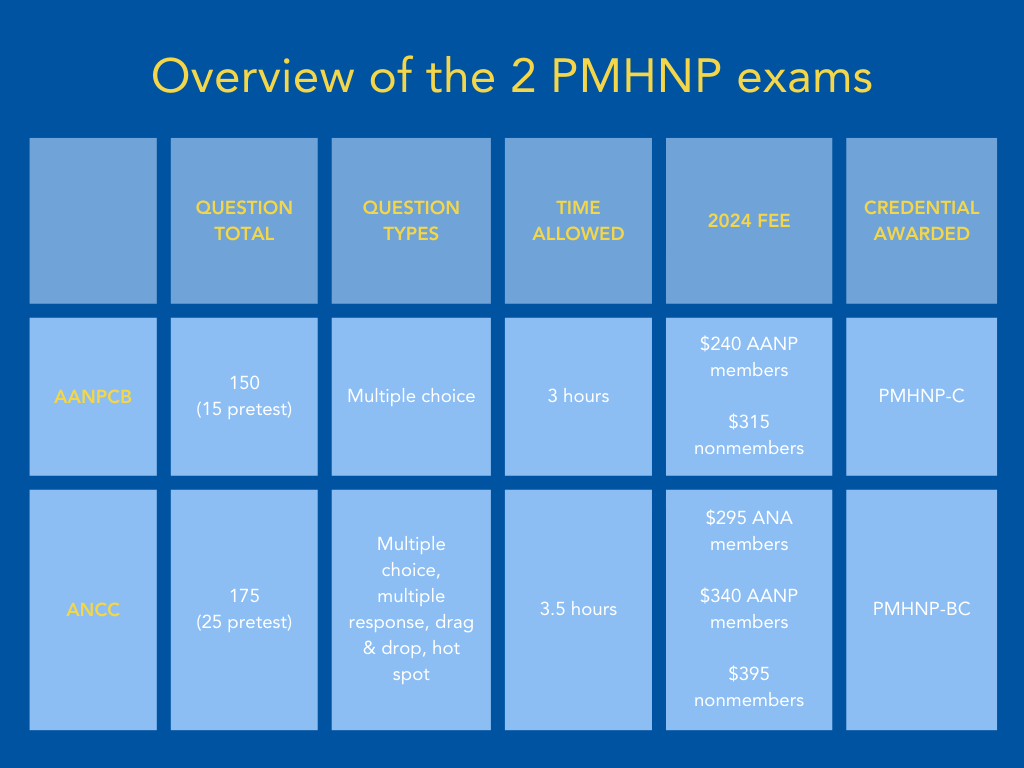
The 150 questions on the new exam are all multiple choice and “limited to content that can be tested in an objective format,” the AANPCB states. The questions “are competency-based and focused solely on the requirements for safe clinical practice.”
A candidate's text score is based on their answers to the 135 questions that are scored. The 15 remaining questions are pretest questions that are not scored. By comparison, the ANCC exam for PMHNPs contains 175 questions, 25 of which are unscored pretest items.
The graphic below provides an overview of the two exams for PMHNPs. A future article will more thoroughly explore the differences between the two tests.
The 4 domains on the AANPCB exam for PMHNPs reflect NP practice
The AANPCB exam blueprint outlines the domains and tasks that are evaluated on the exam, and PMHNP candidates should use this information to focus their study and preparation.
Domains are the areas of major responsibility that constitute professional practice and encompass the tasks performed by NPs. The AANPCB exam blueprint identifies the domains for PMHNP practice as follows:
Domain I: Assess
- Establish and evaluate a therapeutic alliance
- Perform a developmentally appropriate comprehensive psychiatric evaluation; it should include relevant medical and psychiatric history and social determinants of health
- Perform a mental status exam and a comprehensive risk assessment
- Review patient records and gather other appropriate information from relevant sources
- Order and/or administer evidence-based instruments (e.g., scales, screening tools, and diagnostic and laboratory tests)
- Assess readiness for change and barriers to learning and/or care
Domain II: Diagnose
- Interpret results of scales, screening tools, and diagnostic and laboratory tests to inform the diagnostic process
- Synthesize and analyze subjective and objective information to formulate differential diagnoses
- Prioritize potential differential diagnoses; this includes recognizing urgent and emergent conditions and consideration of pertinent medical diagnoses
- Establish a primary diagnosis and any relevant secondary and/or tertiary diagnoses
Domain III: Plan
- Establish a collaborative, patient-centered plan of care that is consistent with best evidence
- Inform the patient of risks, benefits, alternatives, and potential side effects of psychopharmacotherapies
- Select and prescribe pharmacotherapeutics
- Provide psychotherapeutic interventions
- Provide psychoeducation, including health promotion and strategies to prevent risk and illness
- Consult and/or collaborate with interprofessional teams
- Make referrals to other providers, specialists, or programs as indicated
- Determine the most appropriate level of care and facilitate transitions to ensure continuity of care
- Manage psychiatric emergencies and crises
- Ensure the safety of clients, practitioners, and others
- Document patient encounters and use appropriate coding and terminology
Domain 4: Evaluate
- Evaluate the efficacy of the plan of care based on outcomes
- Monitor for and manage side effects and adverse events
- Monitor adherence to the plan of care with consideration of barriers (e.g., financial, cultural, side effects)
- Modify the plan of care as appropriate
- Engage in quality improvement initiatives at the individual and/or systems level
- Practice in conformance with ethical guidelines and legal requirements
- Practice in conformance with scope and standards
The 7 applied knowledge areas evaluated on the PMHNP exam reflect required skills
The AANPCB exam blueprint identifies the following applied knowledge areas as important for candidate preparation:
Scientific foundations
- Anatomy and physiology
- Neuroanatomy and neurophysiology
- Pathophysiology
- Epidemiology of psychiatric disorders
- Psychiatric and medical comorbidities
- Growth and development
Pharmacology
- Pharmacologic therapies, pharmacodynamics, and pharmacokinetics
- Psychopharmacology
- Interactions between classes of medication
- Medication monitoring
- Polypharmacy
- Pharmacogenetic testing
- Complementary and alternative medicine
Nonpharmacologic therapies
- Electroconvulsive therapy
- Repetitive transcranial magnetic stimulation
- Complementary and alternative therapies
Psychotherapies
- Psychotherapeutic foundations
- Individual psychotherapy theories and methods
- Group psychotherapy theories and methods
- Family psychotherapy theories and methods
- Theories of change
Assessment and diagnosis
- Clinical interviewing
- Components of a psychiatric evaluation
- Components of a targeted physical assessment
- Mental health screening and assessment instruments
- Diagnostic and laboratory tests
- Diagnostic decision-making using the Diagnostic and Statistical Manual of Mental Disorders
Care practices
- Developmentally- and age-appropriate care practices
- Mental health promotion and preventive health
- Risk assessment and safety planning
- Harm reduction
- Crisis management and de-escalation techniques
- Least restrictive interventions
- Vulnerable populations
- Trauma-informed care
- Cultural awareness and humility
- Social determinants of health
Professional role
- Evidence-based practice
- Ethical issues and legal requirements
- Scope and standards
- Interprofessional practice
- Professional boundaries
- Provider self-care and wellness
- Therapeutic communication
- Implicit biases
- Health systems and levels of care
- Quality improvement
- Electronic medical records and informatics
- Billing and coding schemes
- Telehealth
Test items include common clinical disorders treated by PMHNPs
Questions on the PMHNP exam from AANPCB assess knowledge of clinical disorders described in the Diagnostic and Statistical Manual of Psychiatric Disorders (DSM); the current version is DSM-5-TR.
The AANPCB blueprint organizes the disorders into three groups that reflect the general frequency with which the disorders are the focus of questions on a typical exam.
Most frequently included:
- Depressive disorders
- Anxiety disorders
- Bipolar and related disorders
- Trauma- and stressor-related disorders
- Substance-related and addictive disorders
- Sleep-wake disorders
- Personality disorders
Somewhat included:
- Schizophrenia spectrum and other psychotic disorders
- Neurodevelopmental disorders
- Obsessive-compulsive and related disorders
- Disruptive, impulse-control and conduct disorders
- Neurocognitive disorders
- Breathing-related sleep disorders
- Gender dysphoria
- Sexual dysfunctions
- Somatic symptom and related disorders
- Feeding and eating disorders
Least frequently included:
- Parasomnias
- Other mental disorders
- Dissociative disorders
- Elimination disorders
- Paraphilic disorders
Proven strategies for passing the PMHNP exam
To be successful on the PMHNP exam from AANPCB or ANCC, the exam preparation experts at Advanced Practice Education Associates (APEA) recommend two key steps: Reviewing the exam blueprint and using it to guide your study, and answering high-level practice questions that provide detailed rationales. Practice until you feel comfortable answering questions accurately at a pace of about 1 minute per question.
The most effective study questions reflect the clinical and practice areas covered on the exam and provide detailed rationales to continue building knowledge. Speaking of knowledge, APEA exam experts emphasize that knowledge-level questions are best used early in an NP program — not to prepare for a certification exam.
Knowledge-level questions ask what a student knows about a topic (the facts), but they don’t require application of critical thinking. All NP certification exam questions require the candidate to critically think about the situations presented — not to state basic knowledge.
APEA has developed a high-level question bank for the PMHNP specialty that builds critical thinking.
MyQBank Psychiatric-Mental Health provides 800 multiple choice questions that reflect the blueprints for both PMHNP certification exams. This bank covers general psychiatric disorders encountered in PMHNP primary care settings, as well as other subject areas covered on the PMHNP certification exam.
All questions provide detailed rationales that build the knowledge and critical thinking abilities necessary to pass the PMHNP certification exam. The questions in MyQBank Psych-Mental Health cover patient presentations throughout the age continuum, ensuring that new PMHNPs are prepared to treat the complete range of patients.
In addition to reviewing the blueprint and answering study questions, take advantage of two free resources provided on the AANPCB website: A guide to test-taking and the PMHNP candidate handbook (the handbook also addresses the FNP and AGPCNP exams).