Increase Retention and Pass Rates for Your NP Program with This Strategy
- March 12, 2025
Share:

Preparing nurse practitioner students for board certification and clinical practice requires academic programs to provide didactic and experiential teaching that builds the foundation for advanced practice. Programs that go a step further can reinforce that foundation and graduate more new NPs who are ready to pass and ready to practice.
This additional step is direct, easy to implement, and effective. It involves a strategy that reinforces curriculum and helps students master the content covered on the certification exams — without significant additional burden on faculty.
Over the past decade, hundreds of NP programs have used this strategy to improve their retention and certification pass rates. This article explains this proven education strategy and provides step-by-step guidance for implementation.
Enhance Learning by Embedding a Review Course into the Curriculum
Given the vast amount of knowledge a nurse practitioner student must acquire during an academic program, it’s no surprise that gaps in understanding and retention occur. Embedding a comprehensive evidence-based review course can fill these gaps and add a layer of deeper understanding of complex information.
“Programs can enhance their faculty instruction by embedding an on-demand video review course into didactic and clinical courses,” said Betty Vicknair, APRN, MSN, PNP, integration specialist for Advanced Practice Education Associates (APEA). “The many programs that have taken this step consistently experience improvements.”
Vicknair, who has been consulting with NP program directors and faculty for more than 10 years, said embedding a review course provides several key benefits. Among them are:
- enhanced curriculum instruction
- proactive learning
- comprehensive coverage of key concepts and content
- strengthened clinical and diagnostic reasoning
- improved clinical judgment
- better program and student learning outcomes.
Research Demonstrates the Effectiveness of Embedded Review Courses
NP programs that embed an APEA review course and APEA study questions report increased pass rates on the certification exams, Vicknair said. In addition, published research supports the benefits of embedding a review course.
A study by Wolf et al, published in SAGE Open Nursing in 2023, determined that embedding a complete board review course was an essential component of a three-tiered model that increased student confidence and exam readiness. The other elements of this model were case analysis roundtables and “on-call scenarios” facilitated by faculty. These complements to a review course developed by the researchers’ program faculty serve the same purpose as APEA study questions with rationales, known as MyQBank.
Feedback from the students who participated in the study provide clear support for this additional layer of learning:
- Prior to completing the review course, 16% of students said they felt ready to answer board-style questions. After the review course, 100% said they felt ready.
- When asked about readiness to prescribe and provide evidence-based care, 33% of respondents said they felt ready before completing the review course. After the review course, 100% said they felt ready.
The proactive nature of this learning approach is a distinguishing characteristic that makes embedding a review course especially effective.
“This proactive approach guides student learning throughout their courses to fill knowledge gaps and increase clinical reasoning and judgment,” Vicknair said. “This means that when it comes to making clinical decisions, they are better prepared.”
Embedded Review Courses Increase Preparedness for Certification and Practice
The chief benefit of embedding a complete review course into the curriculum is that it provides comprehensive coverage of content covered on the certification exams. This focus helps students prepare for exam day by cementing key concepts and adding a layer of knowledge and understanding.
By aligning with body systems and current clinical guidelines, review courses ensure that all essential topics and knowledge areas are covered. This alignment allows students to see the bigger picture and understand how different concepts interconnect, which is crucial for both exams and clinical practice.
To achieve these outcomes, the review course should reflect current blueprints for the certification exam and be paired with detailed practice questions that provide thorough rationales.
The APEA on-demand video review course for university use meets these needs by providing:
- Comprehensive coverage of all key areas
- Lectures cover all body systems included on the exams and relevant for clinical practice.
- Lectures incorporate all knowledge areas tested on the exams for each patient population/specialty (FNP, AGPCNP, PMHNP, AGACNP).
- Lecture content reflects current clinical guidelines and evidence-based practice relevant to each patient population/specialty.
- Each student receives a detailed Course Manual that reinforces lecture content and provides a ready-made study guide.
- The APEA review course is updated annually to reflect any changes to the FNP, AGPCNP, PMHNP and AGACNP exam blueprints from the American Academy of Nurse Practitioners Certification Board (AANPCB), the American Nurses Credentialing Center (ANCC), and the American Association of Critical Care Nurses (AACN).
- Enhanced critical thinking and clinical reasoning
- Study questions in APEA MyQBank, which are focused on patient management scenarios, provide detailed rationales that develop and instill reasoning rather than encourage memorization.
- Answering MyQBank study questions prepares students for success on APEA Predictor Exams and the national certification exams.
- Completing faculty-directed assignments in MyQBank provides continuous learning and reinforcement of key concepts. Faculty can see all student and cohort activity and results in the APEA faculty dashboard.
- Answering MyQBank study questions and completing faculty-assigned quizzes prepares students for real-world clinical scenarios because they depict common patient presentations. Faculty can see all student and cohort activity and results in the APEA faculty dashboard.
- Practice questions embedded throughout the review course test student understanding of the content presented.
- Flexibility, access and customization throughout the program
- One of the distinct advantages of an embedded APEA review course is unlimited access to lectures and study questions throughout the program and for a period of time after graduation. This extended access — not standard with other NP education companies — helps ensure students are prepared and confident on exam day.
- APEA is committed to meeting the unique needs of each program. That’s why it also provides customizable course viewing schedules for students and faculty.
Read more about APEA's comprehensive program and faculty support resources in the Faculty Resource Center.
How to Optimally Integrate This Additional Learning Layer in Curriculum
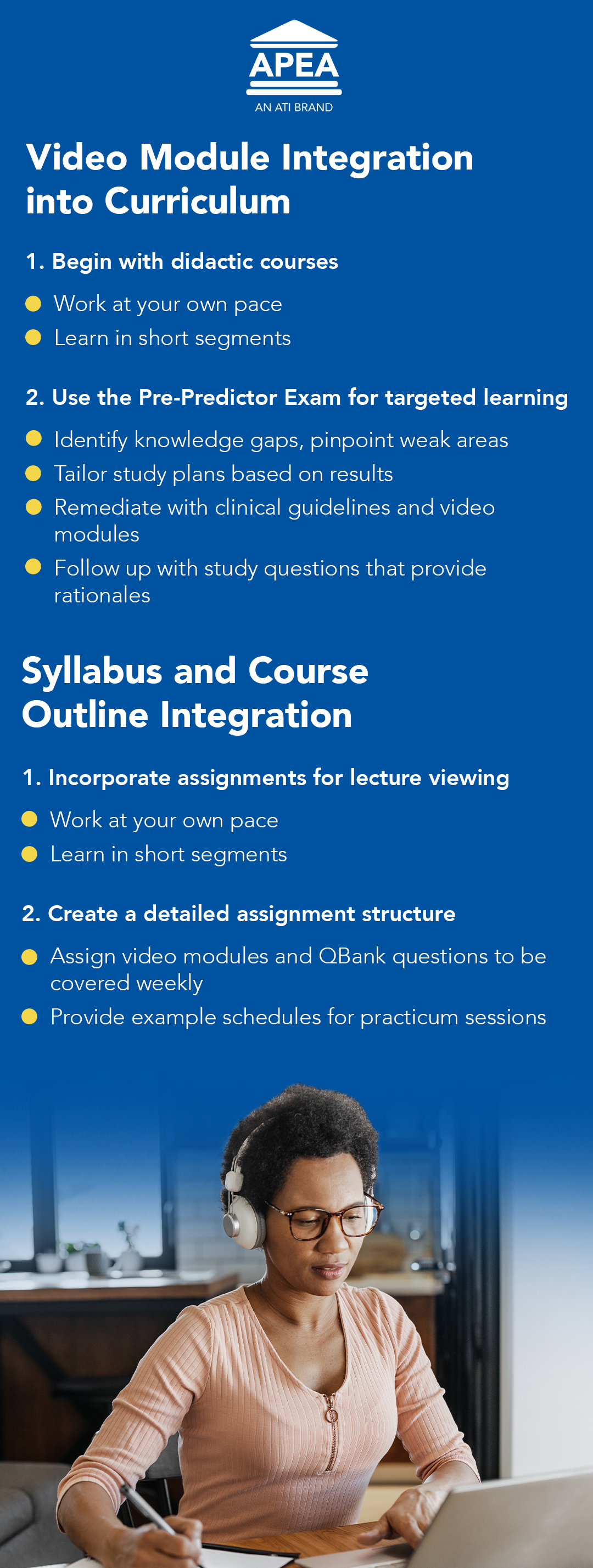
To maximize the benefits of a comprehensive review course, faculty should integrate it strategically throughout the curriculum. Vicknair advises beginning with the first track-specific didactic course and threading the lecture videos throughout remaining courses.
“The modules align with each body system and can be correlated with specific lecture topics to provide students with another avenue to grasp key concepts and content,” Vicknair said. “Programs have the greatest success when faculty spread the video modules over the first three courses in the track-specific section of the program. Then, I recommend assigning the course again as a review in the final course of the program, to remediate after the Pre-Predictor Exam."
This approach ensures continuous reinforcement of key concepts, which is essential for long-term retention, she explained.
The APEA Pre-Predictor Exam, which is the only predictive exam available, plays a crucial role in this strategy by identifying knowledge gaps. Students can then take a reactive approach to focus on identified knowledge gaps, using clinical guidelines, video modules and study questions for remediation.
“For example, if a student scores lower than the predictive score in the cardiovascular knowledge area, they can review what they missed using a clinical guideline book as a reference,” Vicknair said. “After studying in that guideline book, they should view the cardiovascular video module again to further improve their understanding of this system and follow up with questions in the cardiovascular knowledge area in My QBank. This targeted approach ensures that students are well-prepared for both exams and clinical practice.”
For guideline review and general clinical knowledge, Vicknair recommends Clinical Guidelines in Primary Care, a well-known reference that is a commonly required text in primary care NP programs. The 5th edition of this book will be available in summer 2025. Meanwhile, the 4th edition (2021) is available here.
Another important step in adding this valuable layer of learning is to document all assignments in the syllabus for each term.
“Incorporating assignments into the syllabus and course outline ensures that students are aware of the expectations from the beginning,” Vicknair said. “And including these assignments in the LMS allows for easy access and tracking of progress.”
Vicknair advises faculty to require completion reports that serve as proof of viewing and noted that some programs offer course grade incentives for completing assignments. “This not only encourages students to engage with the material but also provides a tangible reward for their efforts,” she said.
Another best practice is the use of discussion groups. These can help address student struggles and clarify concepts, fostering a collaborative learning environment.
“Discussion groups provide an opportunity for students to ask questions and talk about challenging topics with their peers and instructors,” Vicknair said.
Embedding a Review Course Creates a More Structured Learning Path
Embedding an NP review course into the curriculum offers multiple benefits, including enhanced instruction techniques, proactive learning, comprehensive coverage of key content, and improved program outcomes.
By evenly distributing video modules throughout the course, students receive a structured learning path that aligns with each body system and correlates with specific lecture topics, providing another avenue to grasp key concepts and content.
Vicknair said she has seen many NP programs benefit from this strategy. She emphasized that faculty oversight to ensure student accountability, along with support from faculty members, are crucial to achieving optimum outcomes.
“Embedding a review course and required study questions into curriculum creates a well-structured and supportive learning environment that enhances the student experience and helps faculty,” she said. “Students are more likely to stay in a program where they feel adequately prepared and supported.”
To learn more about how to embed a review course into your program, email requestinfo@apea.com.