Struggling to Secure NP Clinical Placements? Start With What You Can Control
- March 31, 2026
Share:
Clinical placements for nurse practitioner students are getting harder to secure. Sites and preceptors can afford to be selective, not only because they’ve reached capacity but because too many NP students are not adequately prepared.
One of the most effective ways academic programs can support both students and preceptors is by ensuring students have cemented their foundational advanced practice knowledge before entering clinical rotations.
When students demonstrate that they have mastered this material, preceptors have a better experience, students flourish, and programs are more likely to build sustainable clinical partnerships.
Why 3P Knowledge Is Foundational to NP Practice
The core of nurse practitioner curriculum is known as the 3 Ps. Advanced pathophysiology, pharmacology, and physical assessment form the foundation of advanced practice nursing. These courses support clinical reasoning, safe prescribing, diagnostic accuracy, and patient management
The 3Ps are so integral to safe practice that the APRN Consensus Model and the Standards for Quality Nurse Practitioner Education mandate their inclusion in every academic program for APRN roles.
Without a solid foundation in the 3Ps, students may struggle to perform accurate patient assessments, develop appropriate differential diagnoses, and make appropriate decisions about patient management. Preceptors are understandably frustrated when students aren’t equipped to begin performing these tasks when they enter clinical rotations.
But when academic programs verify that students have truly achieved 3P knowledge, the picture changes completely. This is where partnership beyond learning content becomes essential.
Evaluating 3P Readiness Before Clinicals: An Evidence-Informed Approach
When academic programs adopt intentional strategies to evaluate 3P mastery before students enter clinical rotations, students, preceptors and programs all benefit.
Programs that implement preclinical 3P readiness checkpoints (see below) get better insights into individual and cohort learning. This means faculty can identify where students have achieved competency and where remediation is needed before clinicals.
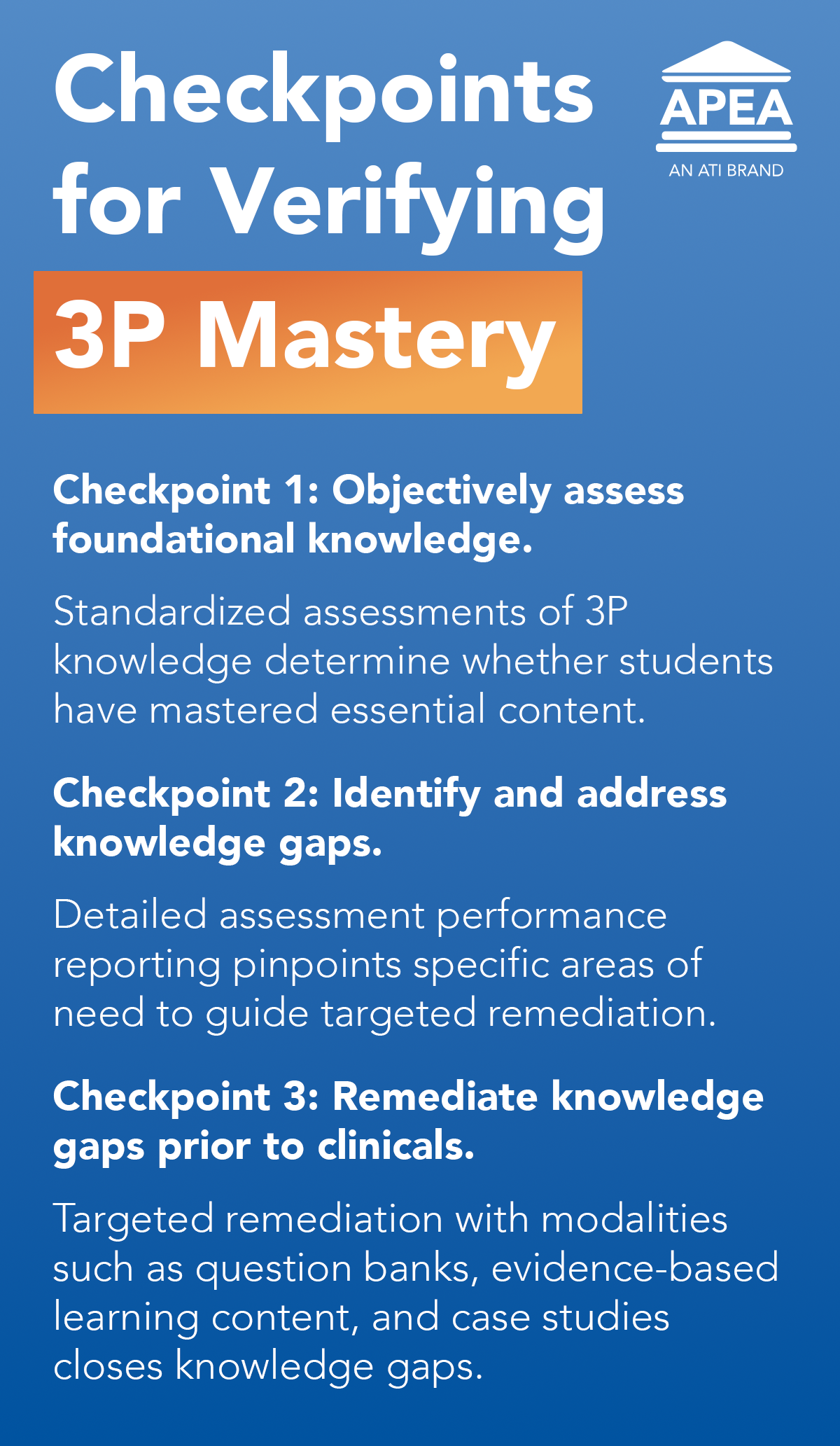
APEA’s suite of 3P resources is built around these exact checkpoints, to address the key dimensions of mastery: knowledge acquisition, knowledge application, and determination of readiness for clinical experiences.
These resources measure and reinforce pathophysiology, pharmacology and physical assessment knowledge in complementary ways, as detailed in the table below. Evaluating 3P mastery before clinicals supports:
- safer learning environments
- more effective use of clinical time
- better preparation for advanced practice.
Let’s dig into the elements of APEA’s approach to building foundational readiness for advanced practice.
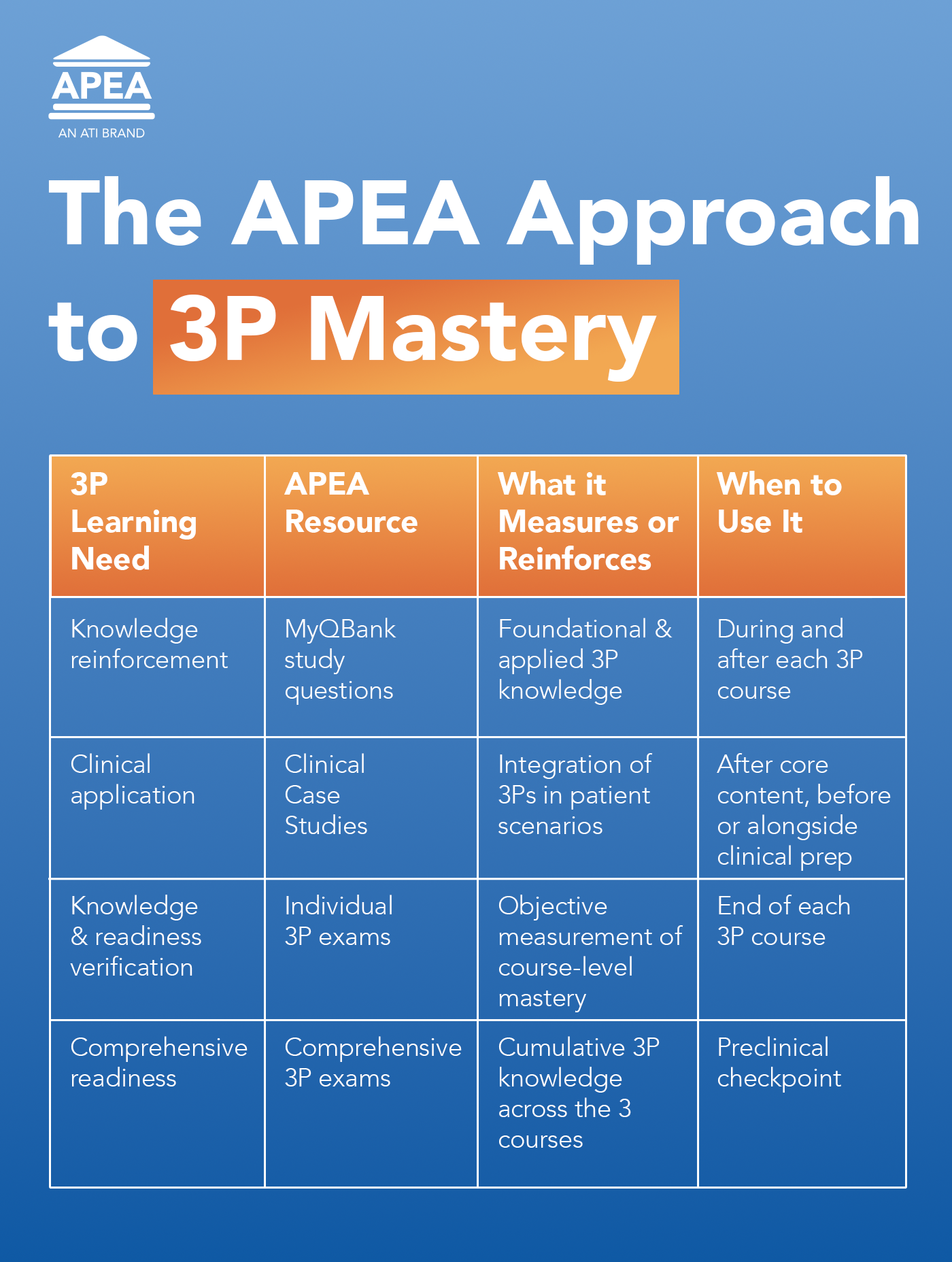
How Programs Build & Evaluate 3P Mastery With APEA:
Using Question Banks to Support 3P Knowledge Retention
For ongoing knowledge reinforcement, APEA question banks (MyQBank) provide practice focused on each 3P subject area. These banks include detailed rationales and quizzing features. They also track knowledge progress over time.
- The pathophysiology, pharmacology and physical assessment question banks help students strengthen knowledge retrieval and connect didactic content to clinical judgment.
- For faculty, the MyQBank performance data provides early visibility into knowledge gaps before they surface in clinical settings.
Using Virtual Clinical Experiences to Prepare for Preceptorships
To assess application, APEA Clinical Case Studies provide students with virtual patient scenarios to practice applying 3P knowledge. Each case study provides detailed rationales to deepen learning.
- Students synthesize advanced assessment data and pathophysiology, prioritize differential diagnoses, and make diagnostic decisions.
- This case-based learning platform helps bridge the gap between theory and practice and strengthens diagnostic reasoning.
- Faculty can review students results instantly, allowing them to tailor class time for any remediation needed to improve understanding.
Using Assessments to Determine Readiness for Clinicals
Individual and comprehensive 3P exams can be used diagnostically or as progression checkpoints to provide objective data that help faculty determine whether to advance a student to clinicals or to provide targeted remediation.
- The Pathophysiology, Pharmacology and Physical Assessment Exams each contain 100 questions focused on the associated subject area.
- The comprehensive 3P exam contains 90 questions that evaluate knowledge of all 3 of the foundational courses.
- All APEA 3P exams are developed using psychometric principles that provide reliability and validity. Psychometricians routinely review and refine item performance and analyze exam results to support consistent measurement.
Using 3P Data to Support Clinical Readiness
When programs use 3P data consistently across courses and checkpoints, faculty can move beyond grades and anecdotal impressions toward more objective, program-level decision-making. They can:
- confirm student readiness prior to clinical placement
- strengthen curriculum outcomes
- reduce variability in student clinical performance
- support consistent progression and remediation decisions across cohorts.
“APEA exams provide real-time data to guide faculty in making accurate decisions about individual student performance, cohort performance, and APRN program effectiveness,” said Daniel Hatch, DNP, APRN, FNP-BC, an APEA integration specialist and NP educator. In this role, he provides custom onboarding to new partner programs, workshops on key education issues, and seminars focused on topics such as curriculum integration, remediation strategies, and how to harness the value of analytics.
“APEA’s analytics are valuable because they are comprehensive. They give faculty a broad program overview down to details of specific student performance,” Dr. Hatch said. “This information instills confidence in a program’s ability to identify student knowledge gaps and evaluate program effectiveness.”
Moving From Assumed Readiness to Verified Readiness
As the competition for clinical placements continues, programs cannot afford uncertainty about students’ 3P readiness. A structured, evidence-informed approach to evaluating and reinforcing pathophysiology, pharmacology and physical assessment knowledge empowers faculty to make confident progression decisions. This objective support benefits both students and preceptors — and ultimately, the patients these new nurse practitioners will care for.
Research links proof of student 3P core knowledge with success on national certification exams, Dr. Hatch said. A 2024 data analysis performed by psychometricians at Ascend Learning, the parent company of APEA, determined that a positive correlation exists between student scores on the APEA comprehensive 3P Exam and the secure APEA University Predictor Exam. Programs that incorporate the APEA University Predictor Exam administer it near the end of a curriculum to predict each student’s likelihood of success on national certification exams.
“Partnering with APEA to provide robust, statistically proven 3P resources increases student confidence,” Dr. Hatch said. “Students know they are receiving quality academic support and a solid educational foundation to build on as they prepare for their new advanced practice role.”
APEA integration specialists are eager to demonstrate how these proven 3P resources fit into your curriculum and progression policies. To connect with APEA about building and measuring 3P mastery in your students, click here.