The Career Outlook for PMHNPs in 2026: A High-Need, High-Demand Market
- June 8, 2026
Share:

Psychiatric-mental health nurse practitioners (PMHNPs) are in serious demand. The stigma around mental health treatment is softening and people are prioritizing mental well-being more than ever. Not surprisingly, medical resources are racing to keep up.¹
In 2024, over 23% of US adults were affected by a mental illness—meaning nearly 1 in 4 of the entire adult population.² On top of that, 137 million Americans now live in mental health professional shortage areas (HPSAs) and these systemic issues restrict an individual's ability to consistently access the right services no matter their motivation or overall need.³
Why? Because the current supply of specialized NPs isn’t enough to meet the demand for mental healthcare practitioners.
The result is twofold: (1) more mental health professionals are needed in general, and (2) advanced practice providers like PMHNPs are becoming essential for bridging geographic and demographic gaps in coverage. Of course, there’s a lot more nuance to this story, which is why many leaders in the industry are taking a closer look.
The market is a mix of widespread shortage and localized saturation.
This country’s shortage of mental health providers is undeniable. Over 40% of the United States population lives in an HPSA, and workforce projections indicate these gaps in coverage will only keep growing.³
Still, this shortage isn’t evenly distributed—from state to state, or from one specialization to another. The 2025 State of the Behavioral Health Workforce also reveals that rural communities are much more likely to experience a shortage of mental health providers, and that’s just the beginning.³
People with lower incomes are also hit hard. Despite improvements to cost-sharing programs, Medicare beneficiaries are still struggling to receive the services they need, especially racial and ethnic minorities.⁴ At the same time, more affluent areas have roughly 25% more access to mental health resources and much higher competition for new practitioners.⁵
All this variance makes for shocking disparities in access to mental healthcare throughout the United States. For example, New Jersey has over 50% of its needs met regarding general access to mental health professionals.⁶ Meanwhile, Arizona, West Virginia, and Delaware can only satisfy 10% or below.
For PMHNPs, this means the promise of opportunity is real, but it's also uneven. That's why the most successful clinicians gain a nuanced understanding of where need is greatest. After all, PMHNPs are not simply shouldering more responsibility for the nation’s mental health. In many cases, they are specifically stepping up where people are suffering from gaps in service.⁷
Christy Cotner, DNP, FNP, PMNHP-BC, an APEA PMHNP faculty member, believes this environment has a direct impact on what is needed for PMHNPs to be successful: “The future of psychiatric practice for PMHNPs will belong to those who know how to think critically, adapt to the market, and still make patients feel seen, heard, and understood.”
The market is fully expanded into telehealth, but collaboration can be an obstacle.
It’s no secret that telehealth services are becoming more common. In general, telehealth utilization spiked drastically in the wake of the COVID-19 pandemic. Even after adoption rates stabilized, 71% of physicians reported providing telehealth services on a weekly basis, which is nearly triple the prepandemic rate.⁸
Not surprisingly, the vast majority of this increase comes from mental health services. In fact, it’s estimated that over 45% of the mental health services offered to Medicare beneficiaries are received through telehealth—compared to just over 3% for all other clinical categories.⁹ Outside of Medicare, the story is much the same.¹⁰
Why? It's partly a preference. Following the pandemic, those receiving mental health services did not return to in-person visits at the same rates as other patients.¹¹ Additionally, mental health services are the only clinical category cleared by Medicare for permanent telehealth coverage. Ultimately, this means the rise of telehealth is transforming the mental health industry more than any other, and many advanced clinicians are standing on the front lines.
For PMHNPs, this means more opportunities and more ways to practice. That said, while these telepsychiatry positions can be incredibly rewarding, they also create additional hurdles for the provider. Restrictions depend on the patient’s location—not the PMHNP, and interstate practice typically requires a license for each state. On top of that, several states require a collaborator or supervisor relationship, and there are sometimes limitations on the initial evaluation.
None of these restrictions are that difficult to satisfy for the average PMHNP. However, they are something a practicing NP should be aware of before making the transition.
More demand is creating more academic options for aspiring PMHNPs.
PMHNP programs have been on the rise since the early 2010s. In 2025, 18% of all NP students were enrolled in PMHNP programs, and nearly 100 new degree tracks have been introduced to the specialization in the last decade.¹²
According to the American Association of Colleges of Nursing (AACN), 374 academic programs across the country are awarding MSN, MSN-to-DNP, and BS-to-DNP degrees.¹³ A number of these are dual-track programs with a small portion offering both FNP and PMHNP certification.¹⁴ Such dual certifications are highly desirable because they make holistic, on-the-spot medical care much more accessible.
Despite all this growth, are programs expanding fast enough to meet market demands? That remains to be seen.¹⁵ One of the most difficult challenges to building successful PMHNP programs is attracting and retaining the right faculty. Unfortunately, the reason qualified faculty are in such short supply is because of the very same deficiencies in the market itself. Recent expansions of the PMHNP market are starting to break the cycle, but it’s a challenge all successful programs had to overcome.
For aspiring PMHNPs, this means more diversity when deciding on academic programs, as well as more nuanced differences to consider between each option. Questions about clinicals, degree structure, and program duration now play a much larger role in long-term career outcomes.
Dr. Cotner believes this also portends an increased level of specialization across the board: “Specialties like women’s mental health, adult ADHD, psychotherapy, and integrated psychiatry are growing quickly, and the more diverse and demanding the market becomes... the more advanced specialization becomes standard.”
Salaries are up, especially for PMHNPs with greater autonomy.
Nurse practitioners already demand significant compensation across the country, and PMHNPs are among the highest paid nurse practitioners. In general, compensation for NPs has a state-level variation between $100,000 and $200,000 per year.¹⁶ Meanwhile, peer-reviewed workforce studies describe PMHNP specialization as consistently above standard compensation for the industry.¹⁷
Actual earnings fluctuate from state to state—and sometimes even within the state itself. One thing remains constant: compensation is especially high for PMHNPs working in states that grant greater autonomy to nurse practitioners. In fact, PMHNPs with full practice authority report higher earnings overall, and they are much more likely to secure stable self-employment.¹⁸
For PMHNPs, this means maximizing your compensation is directly tied to certification tracks and/or physical locations. When NPs consider a move, either from state to state or from job role to job role, they should weigh all the specifics of state authority, including practice models and salary expectations. Additionally, they should investigate the needs of the state, including what is in demand and what is rarely requested by the population.
How do you unlock all your power as a PMHNP?
APEA is a trusted resource for active and aspiring NPs. Not only is it home to the exam review courses with the highest pass rate on the market, but it’s also the host for the NP Student Power Hour.
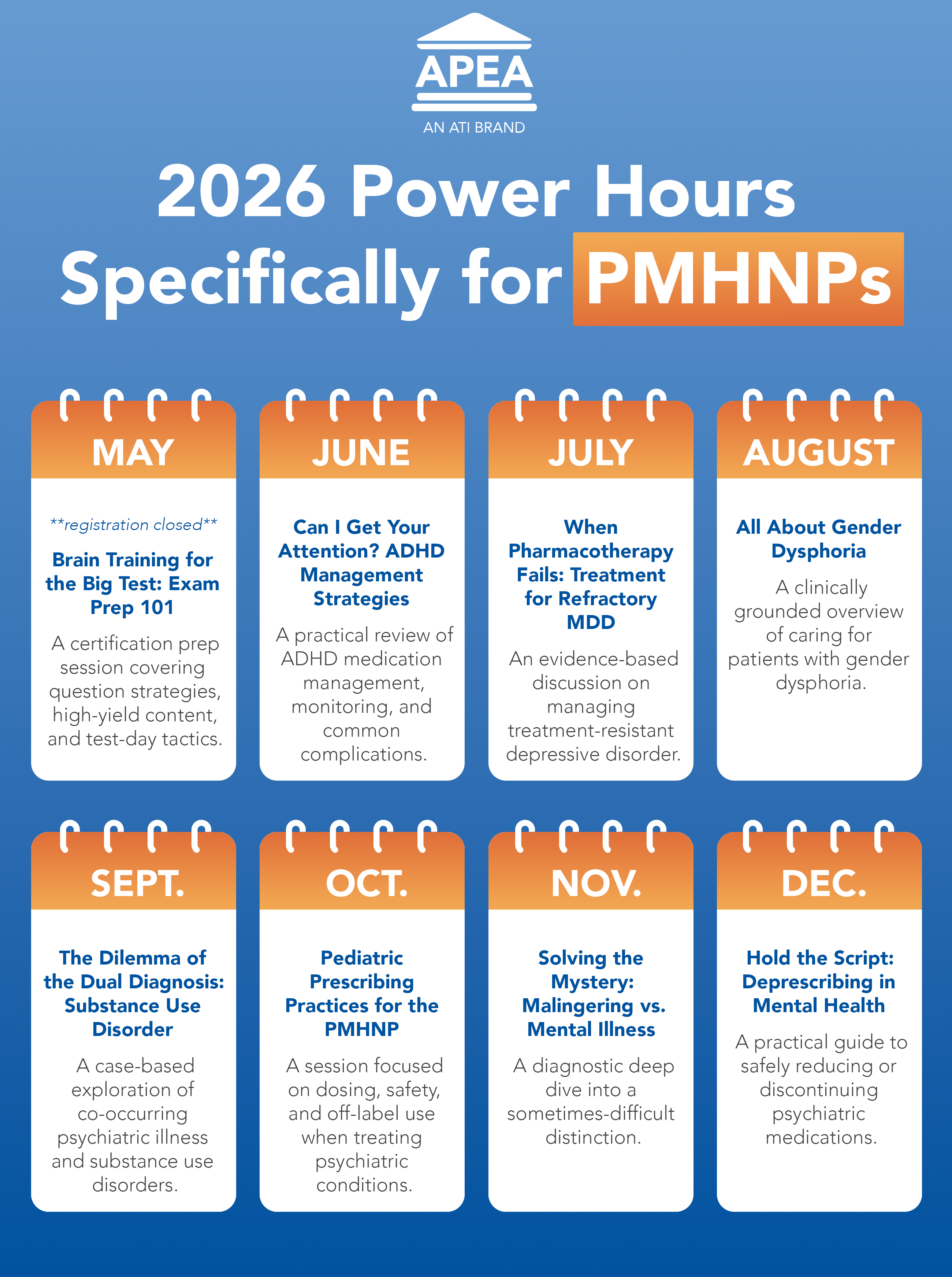
Every month, APEA offers one hour of in-depth analysis and open feedback centered around high-value topics for nurse practitioners. Power Hour covers everything from prescribing guidelines to the latest in diagnosis and management, and many sessions focus exclusively on psychiatric-mental health.
Whether you’re an NP student or an FNP interested in additional specialization, these meetings can prepare you to succeed in today’s PMHNP market. Check the schedule below and register now!
2026 Power Hours Specifically for PMHNPs
-------
Have you chosen the right educational pathway? Have you established a collaborator relationship? Stay tuned for the next installment of APEA’s official career outlook for PMHNPs, a step-by-step guide to successfully entering a rapidly growing market.
REFERENCES
- Kaiser Family Foundation. Exploring the rise in mental health care use by demographics and insurance status. Kaiser Family Foundation. https://www.kff.org/mental-health/exploring-the-rise-in-mental-health-care-use-by-demographics-and-insurance-status/
- Substance Abuse and Mental Health Services Administration. 2024 National Survey on Drug Use and Health: Companion Report. Substance Abuse and Mental Health Services Administration; 2024. https://www.samhsa.gov/data/sites/default/files/reports/rpt56462/2024-nsduh-companion-report.pdf
- Health Resources and Services Administration, Bureau of Health Workforce. Behavioral Health Workforce Brief. Health Resources and Services Administration; 2025. https://bhw.hrsa.gov/sites/default/files/bureau-health-workforce/data-research/Behavioral-Health-Workforce-Brief-2025.pdf
- Fung V, Price M, McDowell A, Nierenberg AA, Hsu J, Newhouse JP, Cook BL. Coverage parity and racial and ethnic disparities in mental health and substance use care among Medicare beneficiaries. Health Affairs. 2023;42(1):83-93. doi:10.1377/hlthaff.2022.00624
- Lombardi B, de Saxe Zerden L, Jensen T, Galloway E, Gaiser M. Behavioral health workforce distribution in socially disadvantaged communities. The Journal of Behavioral Health Services and Research. 2025;52(1):168-179. doi:10.1007/s11414-024-09897-0
- Kaiser Family Foundation. Mental health care health professional shortage areas (HPSAs). Kaiser Family Foundation. https://www.kff.org/other-health/state-indicator/mental-health-care-health-professional-shortage-areas-hpsas/
- Cai A, Mehrotra A, Germack HD, Busch AB, Huskamp HA, Barnett ML. Trends in mental health care delivery by psychiatrists and nurse practitioners in Medicare, 2011–2019. Health Affairs. 2022;41(9):1222-1230. doi:10.1377/hlthaff.2022.00289
- Kane CK. Patient‑Facing Telehealth: Use Is Higher Than Pre‑Pandemic but With Great Variation Across Physician Specialties. American Medical Association; 2024. https://www.ama-assn.org/system/files/2024-prp-telehealth.pdf
- Liu T, Chaitoff A, Ellimoottil C. Telehealth utilization and health conditions addressed among the US Medicare population. Annals of Internal Medicine. 2026. doi:10.7326/ANNALS-25-05028
- Decker S. Use of telehealth in nonmetropolitan and metropolitan areas, United States, 2021–2023. Agency for Healthcare Research and Quality; 2025. https://meps.ahrq.gov/data_files/publications/st570/stat570.shtml
- Cantor JH, McBain RK, Ho PC, Bravata DM, Whaley C. Telehealth and in‑person mental health service utilization and spending, 2019 to 2022. JAMA Health Forum. 2023;4(8):e232874. doi:10.1001/jamahealthforum.2023.2874
- American Association of Nurse Practitioners. Nurse Practitioner Student Trends in Primary Care, Acute Care, and Psychiatric‑Mental Health Programs, 2015–2024. American Association of Nurse Practitioners; 2025. https://storage.aanp.org/www/documents/research/NP_Student_Snapshot_PC_AC_PMH_2015-2024.pdf
- American Association of Colleges of Nursing. Advanced Practice Registered Nurse Enrollment and Graduation Report, 2022–2025. American Association of Colleges of Nursing; 2025.
- Verdi M, Ainslie M. A call to action: Leveraging dual‑certified APRNs to optimize holistic patient care. Journal of the American Association of Nurse Practitioners. 2024;36(10):535-538. doi:10.1097/JXX.0000000000001064
- American Psychiatric Nurses Association. 2025 State of Psychiatric‑Mental Health Nursing. American Psychiatric Nurses Association; 2025. https://omsapaprod.wpenginepowered.com/wp-content/uploads/2025/10/APNA_2025_State_of_Psychiatric-Mental_Health_Nursing_FINAL.pdf
- Bureau of Labor Statistics, United States Department of Labor. Nurse practitioners. Bureau of Labor Statistics. https://www.bls.gov/oes/2023/may/oes291171.htm
- Auerbach DI, Buerhaus PI, Staiger DO. Implications of the rapid growth of the nurse practitioner workforce in the United States. Health Affairs. 2019;38(2):273-280. doi:10.1377/hlthaff.2019.00686
- DePriest K, D’Aoust R, Samuel L, Commodore‑Mensah Y, Hanson G, Slade EP. Nurse practitioners’ workforce outcomes under implementation of full practice authority. Nursing Outlook. 2020;68(4):459‑467. doi:10.1016/j.outlook.2020.05.008