2025 Nurse Practitioner Pass Rates: What the Trends Signal About Student Readiness
- Aug. 6, 2026
Share:
Annual nurse practitioner pass rates are an important part of the student readiness story. They aren’t the whole thing—not even close—but they are strong top-level indicators about the state of NP education and candidate preparedness.
The results for 2024 showed a rebound in pass rates for FNPs, underscoring tighter admissions standards and a renewed focus in foundational knowledge. Conversely, the 2025 results are largely flat.
Overall pass rates in 2025 ranged from 80% to 85%. For the adult-gerontology acute care specialty, first-time pass rates were still significantly higher than those for repeat test takers. Also, different educational pathways produced notably different pass rate outcomes.
Of course, the most important lessons aren’t always the year-over-year differences in the data. For many NP programs, the most important lessons are what these yearly numbers indicate about student readiness.
Simply put, pass rates data offers insight. That insight is part of a much larger effort to ensure graduates are prepared for certification and the high-stakes transition to clinical practice.
For educators and programs, this means taking a good look at annual pass rates, but only as part of a larger look at many other critical indicators of program success. No matter the approach, it all starts with the numbers.
2025 Pass Rates at a Glance
2024 certification data marked a substantial rally for FNPs and included the first PMHNP exam offered by the American Academy of Nurse Practitioners Certification Board (AANPCB), rebranded in 2026 as the Nurse Practitioners Certification Board (NPCB). In comparison, the 2025 certification pass rates appear placid—like a still lake. There were no dramatic swings and no completely new variables to dominate the conversation.
Still, flat growth does not guarantee stability, nor does it mean programs can rest on their laurels when thinking about the future. Even when the headline numbers are steady, several recurring trends and patterns are important elements of the student readiness story.
APEA’s Lead Nurse Practitioner Education Specialist, Kathy Baldridge, DNP, FNP-BC, FAANP, puts it like this: “A placid lake can hide a lot of activity. And that’s exactly what is happening here.”
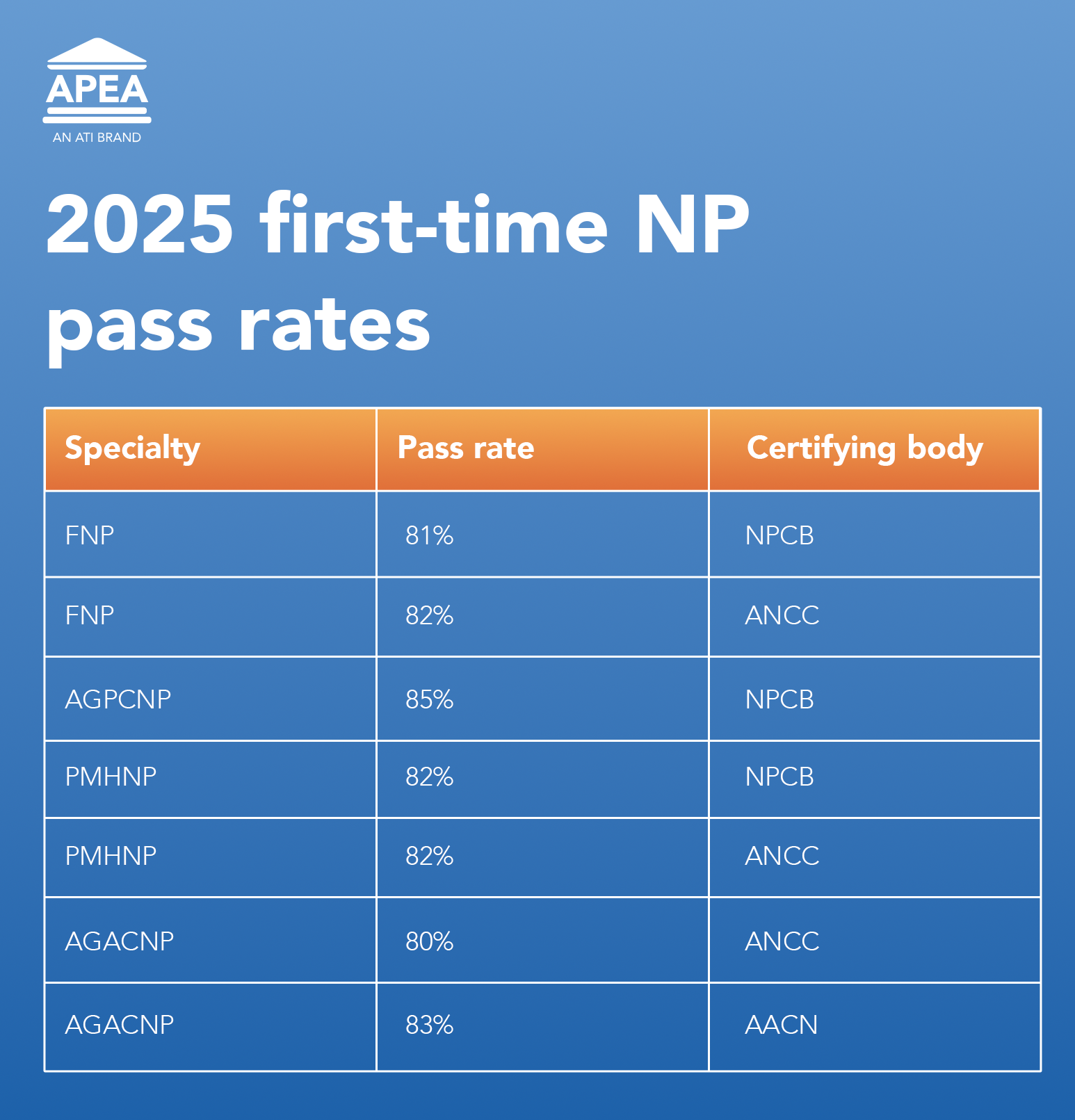
Quick takeaways:
- FNP pass rates declined slightly but remained within historical norms.
- PMHNP pass rates remained consistent despite continued growth.
- AGACNP continues to have the lowest pass rates among specialties.
- AGPCNP posted the strongest results across certifying bodies.
Trend #1: Repeat test takers continue to struggle.
There’s a reason most nurse and nurse practitioner certifying bodies only report first-time pass rates. Simply put, the data gets too complicated to interpret with precision.
This precedent began with the 2006 Texas Board of Nursing report of test performance.¹ What did it show? For the second attempt and beyond, pass rates become influenced by factors that extend well beyond the original educational experience.
Sustainable employment. Review and remediation opportunities. Elapsed time. General aptitude for independent study. Each of these considerations is an essential part of succeeding as a repeat test taker, which is why first-time pass rates appear to routinely outpace repeat performance by a wide margin.
The 2025 AGACNP data, which uniquely still reports both first-time and repeat pass rates, is a perfect reflection of this discrepancy. The AACN reported an 83.1% first-time pass rate compared with a 74.9% overall pass rate, suggesting first-time candidates have significant advantages for success. Beyond that, research centered on general nursing licensure and similar professional certifications also shows that first-time candidates outperform repeat test takers.²‘³
It’s an educational reality—one that can shape successful systems of remediation.
Trend #2: Different degree tracks and different outcomes.
One of the most consistently recurring patterns in recent pass rates is the difference in performance between educational pathways. In some cases, such as 2025 FNP and AGPCNP candidates, there is a distinct progression from post-graduate to DNP students with slight bumps in success for more advanced degrees.
However, the trend isn’t always that linear. For example, 2025 PMHNP candidates posted their strongest results in the post-graduate pathway, indicating that degree choices matter, but not always in predictable ways.
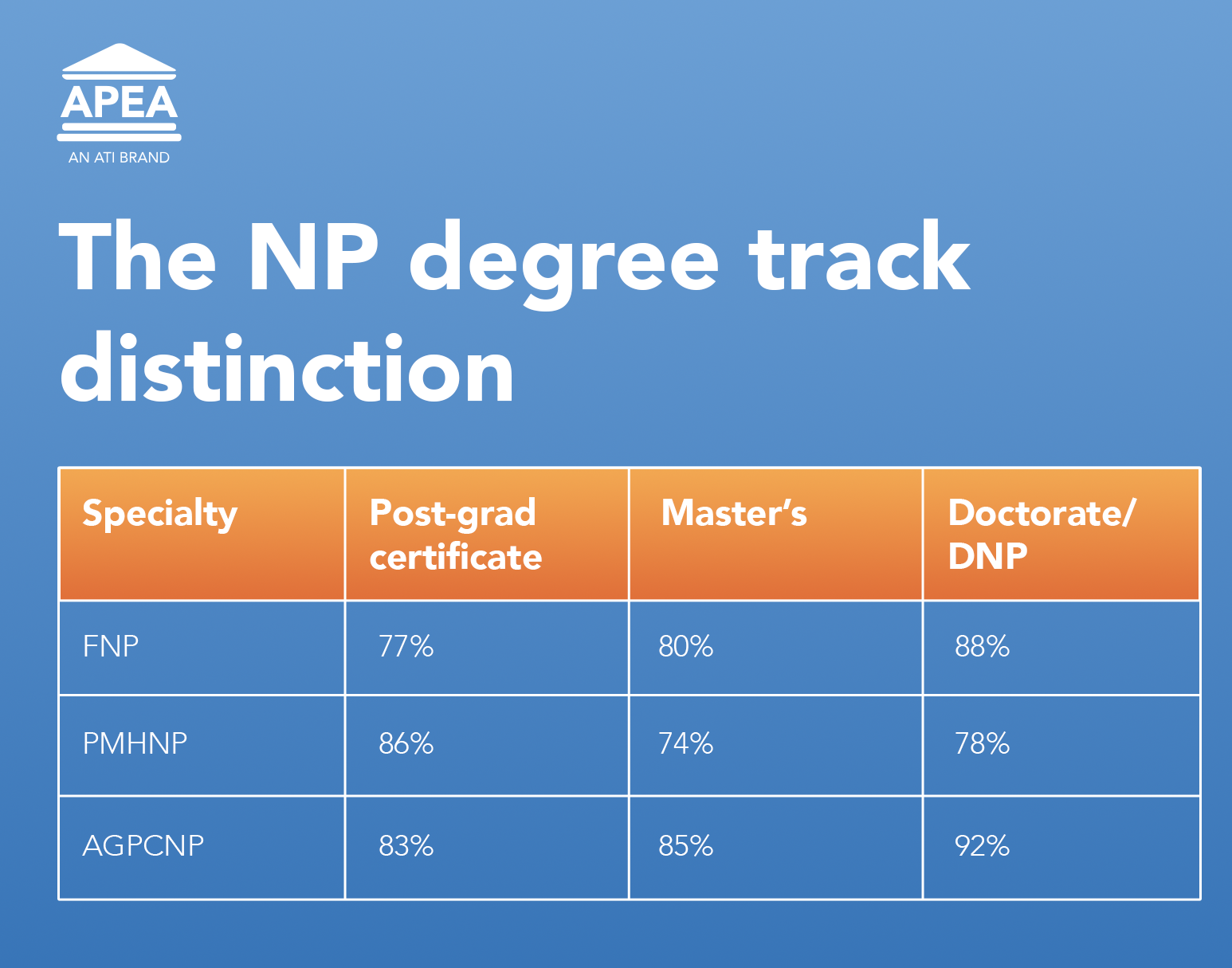
These differences should not be interpreted as proof that one degree track is inherently more effective than another. Certification outcomes are influenced by many factors, including program structure, previous experience, and time spent to graduate. Regardless, the results indicate that an aspiring NP's pathway is a decision with real downstream impacts.
Such early consequences in decision-making pose a different question altogether: "What indicators should programs use to measure readiness before students ever sit for a certification exam?"
The Critical Indicators Beyond Annual Pass Rates
By the time annual NP pass rates are published, the events that shaped them are ancient history—at least in terms of the journey to advanced practice. Pass rates are an important benchmark for top-level trend discussions. However, they are ultimately an outcome and not a comprehensive indication of program health or any specific reflection of the process itself.
That’s why educators need additional critical indicators to explain why students struggle or succeed. These paint a broader, more complete picture of what pass rates data means:
Clinical Reasoning
Certification exams increasingly reward application over memorization. Students must connect assessment findings, 3P knowledge, and evidence-based treatment decisions in real time. That's a skill developed through repeated exposure to clinical scenarios, not last-minute review.
Mastery of the 3Ps
Successful certification outcomes rely on a strong foundation in pathophysiology, pharmacology, and physical assessment. Weaknesses in 3P understanding are potential precursors to certification failure.
Early At-Risk Identification
Student readiness doesn't become a problem overnight. Gaps in coursework and clinical practice often emerge long before graduation. Tools such as APEA's 3P assessments, question banks, and predictor exams help programs detect these issues before they become high-stakes failures.
Remediation Response
Students will struggle. What matters most is how they respond when weaknesses are identified. Effective remediation combines self-assessment, targeted learning interventions, and measurable improvement over time, allowing students to make setbacks part of a journey toward clinical competency.⁴
What This Means About Student Readiness
Taken together, these trends and data sets confirm one simple reality: Certification success doesn’t start just before the exam. Readiness develops over time. It's a slowly built combination of every phase of the NP journey, including foundational 3P knowledge, meaningful assessment, and timely academic intervention.
This means student readiness is not determined by a single exam, course, or semester. It is the result of countless program decisions, most notably the efficiency of student remediation. According to Dr. Baldridge, much depends on whether programs make an impact on those who struggle: “What’s necessary is truly meaningful remediation, including self-assessment and targeted learning interventions.”
The goal is a more comprehensive level of mastery. Certification success is increasingly tied to the ability to apply knowledge rather than recall it. Such application is only possible when gaps in knowledge are adequately addressed and students feel confident in their academic foundations.
Dr. Balridge continues: “NP success is increasingly dependent on a deep understanding of pathophysiology, pharmacology, assessment, and evidence-based decision-making across complex patient presentations.”
What does this mean about overall student readiness? Foundations and remediation are paramount. Programs that consistently reinforce the 3Ps, create intentional opportunities for clinical practice, and actively pursue immediate remediation are best positioned to prepare students for certification success.
How APEA Provides a Readiness Continuum
Student readiness isn’t defined by a single outcome or metric. That’s why APEA provides academic programs with a continuum of ongoing support—one that doesn’t stop until academic readiness translates into certification success. That success is the product of many smaller interventions over time, each driven by a series of critical questions:
- Where and when are students most likely to struggle? APEA's 3P Assessments, Pre-Predictor Exams, and cohort reporting help faculty anticipate the most common challenges to certification success.
- Which students might be at risk? APEA Predictor Exams and readiness benchmarks help programs pinpoint candidates who need additional support before graduation.
- How are knowledge gaps showing up in practice? APEA Clinical Case Studies help students apply classroom concepts to realistic patient scenarios while building clinical reasoning skills.
- Are interventions actually working? Detailed student reports, cohort analytics, and reassessment data help faculty determine whether remediation is producing measurable improvement.
- Are students prepared to think like practitioners? Clinical reasoning and evidence-based decision-making are increasingly tied to certification success.
APEA treats readiness as a continuum rather than an endpoint for the final semester. From foundational 3P assessments and clinical case studies to predictor exams, remediation resources, and certification review, each stage reinforces the one before it—always on and always moving toward certification success.
Consequently, certification success becomes the natural result of consistent preparation. It isn’t a last-minute effort. It’s the culmination of years of assessment, feedback, and nonstop remediation.
Success Starts Long Before Test Day
2025 pass rates were largely stable, with typical recurring trends in repeat test taker performance and sizable differences in degree track success. Repeat test takers continue to struggle, which means remediation efforts are more important than ever. Meanwhile, degree-track discrepancies suggest choices in educational pathways have measurable impacts on certification success.
These pass rates are a single metric—a conclusion to a process that includes clinical reasoning development, foundational 3P knowledge, and meaningful remediation. They are part of the broader continuum of student readiness. That’s why the strongest NP programs focus on preparation throughout the entire NP journey.
APEA services are built on that same holistic philosophy. Analyze pass rates and critical indicators. Treat readiness like a continuum and support students continuously up to the point of certification success.
------
Pass rates data is part of a larger story about student readiness. APEA is a trusted education partner with targeted solutions to meet every challenge.
For information on live and on-demand certification review courses for FNPs, AGPCNPs, PMHNPs and AGACNPs, visit the Courses page.
To connect with a faculty consultant, click here.